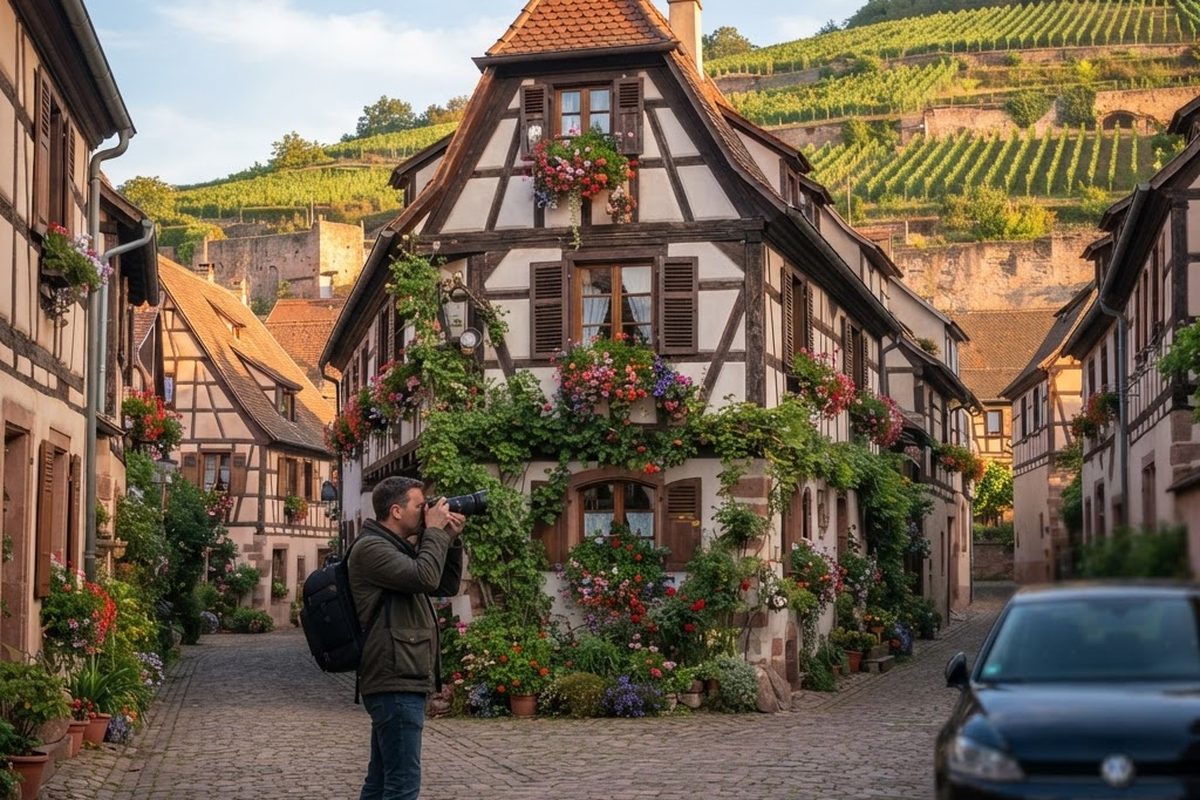
Top photo locations along the Alsatian wine trail
The wine route features extraordinary medieval villages, each offering unique visual compositions for landscape and architectural photography. Eguisheim delights photographers with its concentric cobbled streets, pastel plasterwork, and iconic yellow timber house at Rue du Rempart. Riquewihr boasts impeccably preserved 16th-century facades painted in vibrant shades of blue, green, and ochre.
Further along the trail, Kaysersberg provides dramatic river reflections beneath its fortified stone bridge and ancient castle ruins perched high above the Weiss valley. Turckheim adds historic atmosphere with medieval city gates, ornate fountains, and traditional stork nests perched atop high tiled roofs.
Eguisheim and Riquewihr architectural highlights
Focus on narrow cobblestone alleys in early morning when soft light highlights carved timber beams, window flower boxes, and vintage iron guild signs without crowd interference.
Kaysersberg and Turckheim landscape views
Climb to Kaysersberg castle ruins for panoramic vistas across surrounding Grand Cru vineyards, or capture Turckheim's historic gates illuminated in late afternoon golden light.
Timing your shoot for optimal light and seasonal colour
Lighting conditions heavily dictate success in village and landscape photography. Early morning soft light illuminates narrow streets without harsh contrast shadows, while late afternoon golden hour warms hillside vineyard terraces and stone church spires. Autumn brings vibrant golden vines during harvest season, while spring offers blooming fruit trees against timbered walls.
Winter transforms the wine villages into festive wonderlands, with warm evening illumination contrasting against dark twilight skies. Plan your driving schedule to arrive at key scenic viewpoints 30 minutes before peak light hours to set up your compositions effectively.
Framing half-timbered details and vineyard panoramas
Balance your portfolio between intimate detail shots and wide landscape panoramas. Detail photography thrives on wrought-iron artisan signs, carved wooden doorframes, ancient grape presses, and stone wine cellars. Wide shots benefit from elevated vantage points along vineyard walking paths above the village rooftops.
Using telephoto lenses isolates architectural ornaments against soft vineyard backgrounds, while wide-angle optics capture sweeping street curves and timber facades. Always look for natural leading lines provided by cobblestone gutters, vineyard drainage channels, and vine rows pointing toward distant church towers.
Architectural details and macro compositions
Look for unique wine press relics, antique wooden shutters, and hand-crafted stone arches that tell the story of traditional Alsatian wine making history.
Vineyard hill panoramas and horizon lines
Position yourself on vineyard tracks above Riquewihr or Kaysersberg to capture village rooftops framed by rolling hills, ancient stone watchtowers, and distant Vosges mountain peaks.
Equipment management and vehicle logistics for photographers
Carrying heavy camera gear, multiple lenses, tripods, and lighting accessories across steep cobbled streets can quickly cause physical exhaustion. Furthermore, parking outside medieval walls often requires long uphill walks while carrying heavy equipment bags across rough ground.
Hiring a dedicated chauffeur allows you to keep secondary camera gear, tripods, filters, and extra battery packs safely inside a temperature-controlled vehicle. Your driver drops you off at prime photography spots and meets you at designated exit points down the hill.
Simplifying your photography journey with private transport
Hiring a private chauffeur by the hour (from €50/hour for a Comfort Sedan or €85/hour for a spacious Van, 4-hour minimum) provides ultimate flexibility to chase perfect light across multiple wine villages. Your driver handles navigation, parking fees, and weather adjustments smoothly while you focus on creative framing.
Instant online booking at www.bookprivatetransfer.com applies whenever your photography itinerary starts or ends in Strasbourg or the Bas-Rhin department. If your photo route takes place entirely outside Bas-Rhin, individual custom quotations are quickly arranged via WhatsApp (+33 6 28 80 13 23) or email.